
Chariton Projected and Actual Release
A projected date is an administrative estimate based on facts currently available. Those facts can include the judgment, sentence start, custody credit, concurrent or consecutive terms, statutory minimums, parole eligibility, conditional release, and outside holds. The estimate can change when an input changes. Actual release is the completed custody event recorded by the jail or corrections agency.
The distinction is sharp for Chariton County. Randolph County Jail physically houses Chariton detainees under the current arrangement. A Chariton judge may enter a bond, dismissal, time-served, or sentence order, but Randolph records when processing ended and whether another hold led to transfer. For a MODOC prisoner, the state system controls its own sentence and release fields.
Scheduled versus actual: A projected, minimum, conditional, or presumptive date is not proof of exit. Confirm the final status and physical release transaction.
A pretrial detainee normally has no computed sentence release date. The relevant question is whether the court authorized release and whether the jail found another hold. Roster absence does not fill that gap.
Find a Chariton Release Date
Start by identifying the custody system. A person at Randolph on a Chariton case follows the county court and jail path. A person sentenced to Missouri prison follows MODOC. A federal or immigration transfer requires the federal system and cannot be calculated from the Chariton docket alone.
- Confirm the person with a booking number, DOC ID, date of birth, and case number where available.
- Check the Chariton Case.net docket for the judgment, sentence, bond order, jail credit, and later warrants.
- For state custody, open the MODOC Offender Web Search and read the precise date label shown.
- For a county sentence, ask Randolph for the jail calculation and Chariton’s court for the controlling order.
- Check for consecutive cases, detainers, parole action, and later changes before relying on the date.
- After the event, obtain the actual release or transfer record from the agency that held the person.
MODOC’s public web search covers current offenders, including people on active community supervision, but official Missouri Courts guidance says it does not provide discharged people. The nightly all-current-and-prior file is the historical state fallback. It contains fields such as DOC ID, cause number, sentence county, sentence date, sentence length, Completed Flag, Sentence Maximum Release Date, and Sentence Minimum Release Date.
The file is charge-level, so one person can have several rows. A Completed Flag of Y for one sentence does not prove all sentences and holds ended together. MODOC also warns that the data are working files and may be incomplete or unverified. The Chariton County release lookup explains where county, court, and state proof diverge.
Three Missouri Release Dates
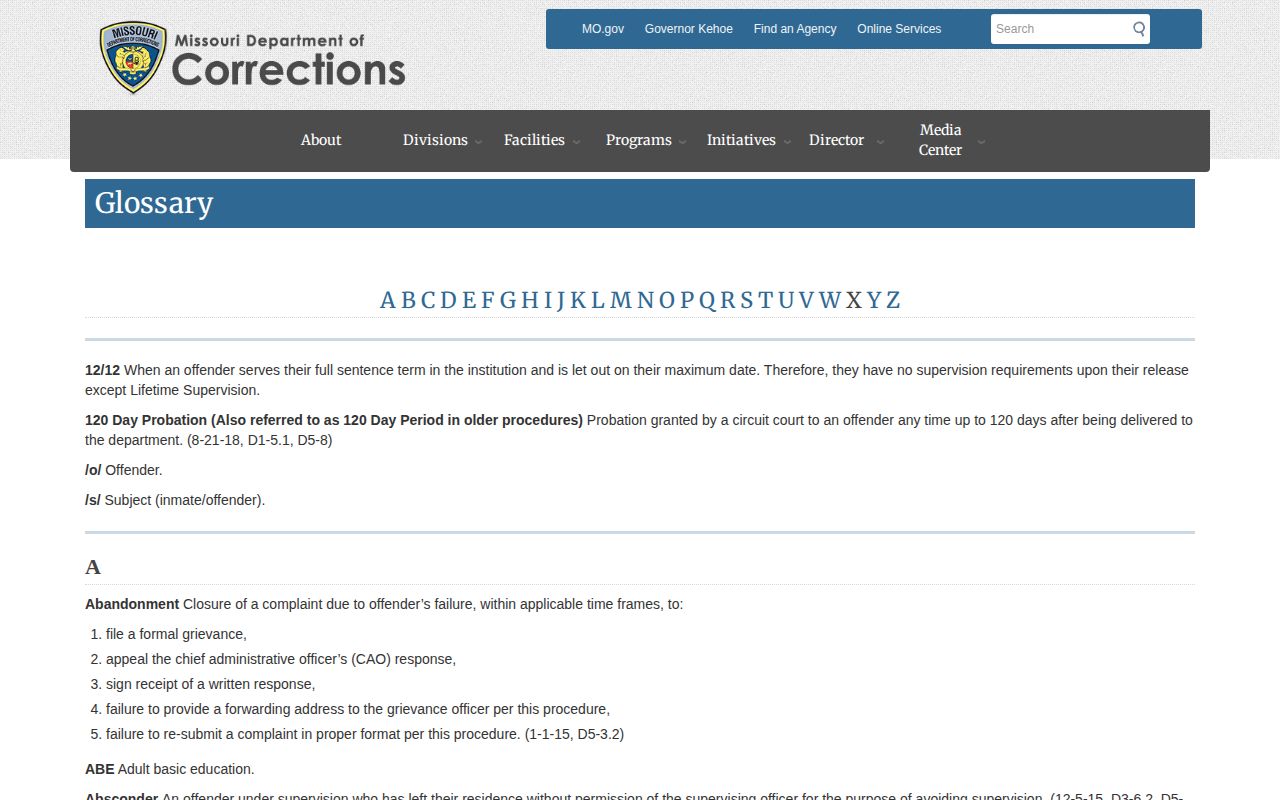
Missouri uses three labels that are easy to confuse. The MODOC glossary defines Maximum Release Date as the full-term date and Minimum Release Date as the conditional-release date. A Presumptive Parole Release Date is a tentative Board date that depends on continued appropriate institutional behavior and an acceptable release plan.
| Date | What it means | What it does not prove |
|---|---|---|
| Maximum release | The full-term date reflected in the state calculation. | That the person must remain confined until that date. |
| Minimum release | The conditional-release date under the applicable sentence structure. | That no legal restriction, violation, or hold can change the outcome. |
| Presumptive parole release | A tentative Board date subject to conduct and an acceptable plan. | That the Board plan has become a physical release. |
The official glossary source shows the terminology used to distinguish Chariton County state-prison release dates.
Always reproduce the exact current label shown for the person instead of replacing it with “guaranteed release date.”
MODOC historical files also use special numeric values that are not calendar dates. Values such as 99999999 for life, 88888888 for some indeterminate or interstate matters, and 66666666 for a field court assessment must never be printed as dates.
Chariton Sentence Terms and Release
Section 558.011 describes prison and conditional-release portions for eligible Missouri term sentences. For eligible terms of nine years or less, the conditional-release term is one-third. For terms over nine through fifteen years, it is three years. For terms over fifteen years, it is five years, with the prison term forming the balance. Statutory exceptions matter, including dangerous felonies and specified repeat commitments.
This structure does not create a do-it-yourself date. The offense, offense date, sentence, multiple counts, prior commitments, and controlling law all matter. The Board may extend a conditional-release date after the required violation process. Consecutive terms can change the whole calculation.
Section 558.019 provides an 85-percent minimum prison term for a statutorily defined dangerous felony, subject to the statute’s terms and age or served-time alternative. That rule is not universal. “Minimum prison term” concerns eligibility for parole, conditional release, or another early release. It is not an exit guarantee.
Section 217.690 governs parole authority. Reaching an eligibility point does not require the Board to release someone. The correct sequence is judgment, current statute, agency calculation, Board action where applicable, current status, and then the executed release record.
Chariton Credits Are Not One Rule
No Chariton-specific jail good-time policy or weekend-release rule was found. An individual county calculation must therefore go to Randolph Jail, the sentencing court, or both. Jail credit shown in the judgment and the jail’s sentence calculation should be compared, not guessed from the booking date.
Section 217.703 earned compliance credits concern eligible probation, parole, and conditional-release supervision. An eligible client can receive thirty days of credit for a full compliant calendar month, subject to exclusions. Accrual can stop for a violation report, absconder status, custody, or a revocation or suspension motion.
Those credits shorten a community supervision term. They are not county-jail “good time,” and they do not move the earlier prison-door event retroactively. A state date, a county sentence date, and a supervision discharge date may all answer different questions about the same person.
Why Chariton Release Dates Change
Every projected date rests on current inputs. A later record can change the legal or administrative calculation, while a new hold can prevent physical release without altering the original sentence term.
| Change | Effect on the release question |
|---|---|
| Corrected jail credit | Changes credited custody time used in the responsible agency’s calculation. |
| Concurrent or consecutive terms | Changes whether sentences overlap or run one after another. |
| Conduct or program issue | Can affect a tentative parole plan or another available release path. |
| Parole decision | May deny release, set another hearing, or establish a future presumptive date. |
| Court order | Can change the sentence, bond, warrant, or custody authority. |
| Detainer or outside warrant | Can cause transfer or continued custody after the first case permits release. |
A parole hearing also takes time. Missouri’s process page says decisions commonly take about eight to twelve weeks. A hearing can lead to another hearing in one to five years or a future date, but neither result is the jail-door event. Use the exact Board terminology.
Note: A court order explains release authority; the holding agency’s transaction shows whether and when the person actually left that custody.
Confirm Chariton Physical Release
For a Chariton detainee expected to leave county custody, obtain the Chariton court order and ask Randolph Jail for its physical release timestamp, release type, and any receiving agency. Randolph’s published main number is 844-277-6555. Chariton Sheriff’s number is 660-288-3277. The court record and jail transaction should be read together.
For a state prisoner, pair the current MODOC date label with parole action and current status. Register through the Chariton VINELink check when a pending custody alert would help, then confirm the message with MODOC. MOVANS can report transfer and other changes, so an alert must not be shortened to “released” without reading it.
For formal historical proof after discharge, use the nightly all-offender data with its field definitions or request the specific MODOC record. For a county-only person, request Randolph’s booking and release record instead. MODOC is not Chariton County’s historical booking archive.
Check Chariton Dates Without Guessing
A safe review begins with the judgment, not an online sentence calculator. Identify every count and case. Determine whether the terms run at the same time or one after another. Verify credited custody days from the official record. Then identify the law in force for the offense date and ask the responsible agency for its current calculation.
Even that sequence produces an estimate until the custody event occurs. A corrected judgment, another warrant, a disciplinary matter, a Board action, or a receiving-agency hold can change what happens. The absence of a name from Randolph’s current roster cannot supply a projected or actual date.
When records conflict, preserve each label and its source. Ask Chariton’s court about the order, Randolph about county custody, and MODOC about a state sentence. Do not merge a maximum date, a minimum date, and a presumptive parole date into one generic answer.
A county bond or dismissal order follows a different timeline from a state sentence calculation. Jail staff still must receive and verify the order, check other warrants or detainers, complete the custody record, return permitted property, and arrange any transfer. The court-entry time and physical-release time can therefore differ without either record being wrong.
For a parole case, a hearing, a favorable decision, and an executed release are three separate events. Missouri’s published process allows time for a decision, and the Board can set a future presumptive date that depends on conduct and an acceptable release plan. Pair the Board record with current MODOC status and the final institution transaction before calling the date actual.